
How Artificial Intelligence Is Transforming AI in HR Today
How Artificial Intelligence Is Transforming AI in HR

Content
Human resources departments face mounting pressure: shrinking budgets, talent shortages, and employees expecting personalized experiences. AI in HR has emerged not as a futuristic concept but as a practical solution already deployed across organizations from 50-person startups to Fortune 500 enterprises.
The numbers tell part of the story. Gartner research shows 76% of HR leaders believe their organizations will fall behind if they don't adopt AI solutions within the next 12-24 months. Yet many HR professionals remain uncertain about where AI fits into their workflows, which tools deliver actual value, and how to avoid expensive implementation mistakes.
This guide cuts through the hype to examine what's working right now in AI-powered human resources.
What AI in HR Actually Means for Modern Workplaces
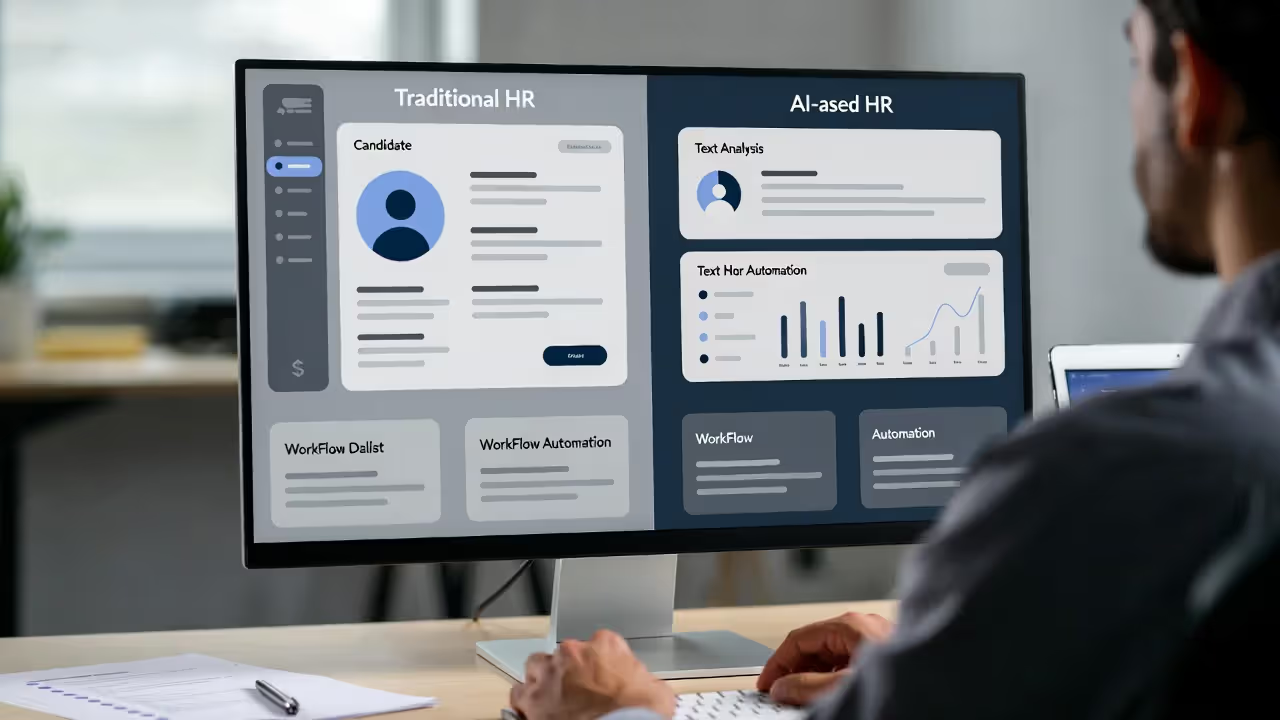
The use of AI in HR refers to machine learning algorithms, natural language processing, and predictive analytics applied to workforce management tasks. Unlike traditional HR software that follows preset rules—"if an applicant has X years of experience, move them to the next round"—AI systems learn from patterns in historical data to make increasingly refined predictions and recommendations.
Traditional automation handles repetitive tasks through fixed logic. You might automate sending an email three days after someone applies. That's helpful but limited.
AI goes further by analyzing unstructured data like resume text, interview responses, or employee survey comments to identify patterns humans would miss. A machine learning model might discover that employees who complete certain training combinations within their first 60 days show 40% better retention rates—an insight buried in thousands of employee records.
Generative AI represents the newest category. Tools like ChatGPT and Claude create original content—job descriptions, policy documents, training materials—based on prompts. Rather than analyzing existing data to make predictions, generative models produce new text, images, or code. An HR manager might prompt: "Write an inclusive job description for a senior data analyst emphasizing skills over credentials," and receive a polished draft in seconds.
The distinction matters because these technologies require different implementation approaches, data requirements, and risk management strategies.
Author: Jonathan Carver;
Source: alignedleaderinstitute.com
8 Proven AI Use Cases Transforming HR Departments
Recruitment and Candidate Screening
Resume screening AI processes hundreds of applications in minutes, identifying candidates whose experience matches job requirements. Platforms like Workday and SAP SuccessFactors use natural language processing to parse resume formats, extract relevant skills, and rank applicants against position criteria.
HireVue takes this further with AI-powered video interview analysis, evaluating candidate responses for communication patterns and relevant experience mentions. The system flags promising candidates while reducing time-to-hire by 30-50% according to customer case studies.
Employee Onboarding and Training
AI chatbots answer new hire questions 24/7 during those overwhelming first weeks. Instead of waiting for HR to respond about benefits enrollment or equipment requests, employees get instant answers through conversational interfaces integrated into Slack or Microsoft Teams.
Adaptive learning platforms like EdCast analyze how individual employees progress through training materials, adjusting content difficulty and suggesting relevant courses based on role requirements and learning patterns. A sales rep struggling with product knowledge modules might receive additional microlearning content automatically, while faster learners skip ahead.
Performance Management and Predictive Analytics
Continuous performance tracking tools aggregate data from project management systems, communication platforms, and peer feedback to give managers real-time visibility into team performance. Rather than relying solely on annual reviews, AI systems identify performance trends and potential issues months earlier.
Predictive analytics models forecast flight risk by analyzing factors like tenure, promotion timing, compensation relative to market rates, and engagement survey responses. When an AI system flags a high-performing engineer as 70% likely to leave within 90 days, proactive retention conversations can happen before the resignation letter arrives.
Employee Engagement and Retention
Sentiment analysis tools scan employee survey responses, internal communications, and feedback channels to gauge organizational mood. Rather than waiting for quarterly engagement surveys, HR teams spot emerging issues—like frustration with a new policy or concerns about workload—within days.
Personalized benefits recommendations use AI to suggest health plans, retirement contribution levels, or professional development opportunities tailored to individual employee situations. A working parent might receive childcare benefit information, while someone nearing retirement gets targeted financial planning resources.
Real-world examples span industries. Unilever reduced hiring time by 75% using AI screening and video interview tools. IBM's Watson analyzes employee data to predict retention risks with 95% accuracy. Hilton deployed an AI chatbot that answers 96% of candidate questions without human intervention, freeing recruiters to focus on relationship building.
How AI Is Reshaping HR Recruitment From Application to Offer
Recruitment represents the most mature application of AI in HR, with tools addressing nearly every hiring stage.

Author: Jonathan Carver;
Source: alignedleaderinstitute.com
Resume screening algorithms parse applications against job requirements, but sophisticated systems go beyond simple keyword matching. They identify transferable skills—recognizing that a project manager from healthcare might excel in a financial services role despite lacking industry experience. Semantic analysis understands that "led a team" and "managed direct reports" describe similar capabilities.
Candidate matching engines work bidirectionally. Instead of just filtering applicants for a specific role, platforms like Eightfold AI and Phenom match existing candidates in your database to newly opened positions. That marketing coordinator who applied six months ago might be perfect for your current content manager opening, and the AI surfaces that connection automatically.
Interview scheduling sounds mundane until you've exchanged 15 emails trying to coordinate calendars across four interviewers and three candidates. AI scheduling assistants integrate with calendar systems, identify available time slots, send invitations, and handle rescheduling requests through natural language email exchanges that feel surprisingly human.
Bias reduction remains controversial but shows promise. By removing names, graduation dates, and other demographic indicators from initial screening, AI can reduce unconscious bias—though only if the training data itself isn't biased. Textio analyzes job posting language to identify phrases that inadvertently discourage certain demographic groups from applying. Words like "rockstar" or "ninja" skew male in applicant pools, while "support" and "assist" attract more female candidates.
Recruitment chatbots handle candidate questions throughout the application process. They explain benefits, describe company culture, provide application status updates, and schedule interviews through conversational interfaces available 24/7. This consistent communication improves candidate experience while reducing recruiter workload by 40-60%.
The trade-off? Implementation complexity. Effective recruitment AI requires clean historical hiring data, clear success metrics (what makes a good hire?), and ongoing monitoring to catch algorithmic drift or bias. A rushed implementation can automate bad hiring practices at scale.
Generative AI Tools HR Professionals Are Using Right Now
Generative AI exploded into HR workflows following ChatGPT's November 2022 launch. Unlike specialized HR platforms requiring lengthy implementations, HR professionals started using these tools immediately for everyday tasks.
Job description writing tops the usage list. An HR manager prompts: "Write a job description for a customer success manager at a B2B SaaS company, emphasizing skills over degrees, with salary range $75-95K." The AI produces a complete draft including responsibilities, qualifications, and benefits messaging—cutting a 45-minute task to five minutes of editing.

Author: Jonathan Carver;
Source: alignedleaderinstitute.com
Policy document creation follows similar patterns. Rather than starting from blank pages, HR teams prompt generative AI to draft remote work policies, social media guidelines, or expense reimbursement procedures based on company values and legal requirements. The AI provides structure and language that HR professionals then customize.
Employee communications get the generative treatment too. Announcement emails about benefits changes, responses to common HR questions, or internal newsletter content all flow faster with AI assistance. The key shift: HR professionals move from writers to editors, reviewing and refining AI-generated drafts rather than creating from scratch.
Training content development accelerates dramatically. An L&D specialist might prompt: "Create a 10-question quiz on workplace harassment prevention with scenario-based questions and explanations for each answer." The AI generates quiz content that would have taken hours to develop manually.
HR-specific generative tools have emerged too. Paradox's AI assistant Olivia specializes in recruitment conversations. Leena AI focuses on employee service requests. These purpose-built tools understand HR context better than general models, though they lack the flexibility of ChatGPT or Claude for unexpected tasks.
The caution: generative AI makes confident mistakes. It might cite non-existent laws, suggest policies that violate regulations, or produce biased language. Every AI-generated piece requires human review, particularly for legally sensitive HR content. Think of generative AI as an enthusiastic junior colleague who works incredibly fast but needs supervision.
Comparing Top AI HR Tech Platforms and Solutions
| Platform Name | Best For | Key AI Features | Starting Price Range | Integration Capabilities |
| Workday | Enterprise-wide HR management | Predictive analytics for retention, skills matching, intelligent document processing | $99+ per employee/year | Extensive API, pre-built connectors for 200+ apps |
| SAP SuccessFactors | Large organizations with complex needs | AI-powered recruiting, personalized learning recommendations, succession planning | $84+ per employee/year | Deep SAP ecosystem integration, custom API available |
| HireVue | Video interviewing and assessment | AI interview analysis, game-based assessments, candidate ranking algorithms | $35,000+ annual license | ATS integrations (Workday, Oracle, SAP), calendar systems |
| Eightfold AI | Talent acquisition and mobility | Deep learning for candidate matching, internal mobility recommendations, market talent insights | Custom pricing (typically $50K+ annually) | Integrates with major ATS/HRMS platforms via API |
| Phenom | Candidate experience and recruitment marketing | Personalized job recommendations, chatbot, automated campaign management | $30,000+ annually | 40+ native integrations including major ATS platforms |
| Leena AI | Employee service and support | HR chatbot, ticket automation, knowledge base search | $4-8 per employee/month | Slack, Teams, ServiceNow, Workday integrations |
Selection criteria depend heavily on organizational context. Companies under 500 employees rarely need enterprise platforms like Workday—the implementation complexity and cost outweigh benefits. Mid-sized organizations (500-2,000 employees) often succeed with specialized point solutions addressing specific pain points: HireVue for recruiting, Leena AI for employee service.
Budget considerations extend beyond license fees. Implementation costs typically run 1-2x the first year's licensing fees for enterprise platforms. Factor in data migration, integration development, training, and change management. A $100K annual platform might cost $250K in year one.
Integration capabilities matter more than feature lists. The sleekest AI recruiting tool becomes useless if it can't exchange data with your existing ATS and HRMS. Prioritize platforms with pre-built connectors to your core systems or robust APIs if you have development resources.
Common Mistakes When Implementing AI in HR (And How to Avoid Them)
Deploying AI without strategic clarity tops the failure list. HR teams get excited about AI capabilities and implement tools without defining what problems they're solving. You end up with an expensive chatbot that answers questions employees weren't asking or a recruiting tool that optimizes for the wrong success metrics.
Start with problems, not solutions. Identify your top three HR pain points—maybe time-to-hire exceeds 60 days, voluntary turnover hits 25%, or benefits questions overwhelm your two-person HR team. Then evaluate whether AI addresses those specific issues better than alternatives.
Data privacy and security concerns get overlooked until they become crises. HR data includes sensitive personal information, health records, performance evaluations, and compensation details. AI systems require access to this data for training and operation, creating expanded risk surfaces.
Before implementing AI tools, audit what data they'll access, where it's stored, how it's secured, and who can view it. Ensure vendors comply with relevant regulations—GDPR if you have European employees, CCPA for California residents, HIPAA for health data. Get legal review on data processing agreements.

Author: Jonathan Carver;
Source: alignedleaderinstitute.com
Insufficient training undermines adoption. HR teams receive new AI tools with minimal guidance, struggle to use them effectively, and revert to familiar manual processes. The AI investment sits unused.
Plan for substantial training time. Budget 20-40 hours per HR team member for enterprise platform implementations. Create internal champions who develop deep expertise and support colleagues. Schedule refresher training quarterly as people forget features they don't use regularly.
Over-automation damages employee experience. Enthusiastic AI adopters automate everything possible, removing human touchpoints that employees value. A completely automated onboarding process might be efficient but leaves new hires feeling disconnected and confused.
Maintain human involvement at critical moments: offer letters, performance reviews, sensitive employee relations issues, terminations. Use AI to handle routine questions and administrative tasks, freeing HR professionals for high-value interactions requiring empathy and judgment.
Algorithmic bias represents the most publicized risk. AI systems trained on historical data perpetuate existing biases—if your company historically hired mostly men for engineering roles, the AI learns that pattern and recommends male candidates. Amazon famously scrapped an AI recruiting tool in 2018 after discovering it penalized resumes containing the word "women's."
Mitigate bias through diverse training data, regular algorithm audits, and human oversight of AI recommendations. Test systems across demographic groups to identify disparate impacts. Never allow AI to make final hiring, promotion, or termination decisions without human review.
The biggest mistake I see is organizations treating AI as a 'set it and forget it' technology. AI systems require continuous monitoring, retraining, and adjustment as your workforce and business needs evolve. The companies succeeding with AI in HR dedicate ongoing resources to system maintenance and improvement, not just initial implementation.
— Dr. Ben Eubanks
Frequently Asked Questions About AI in HR
AI in HR has moved from experimental to essential. The organizations seeing real value approach AI as a capability enhancement, not a replacement strategy. They start with clear problems, choose tools addressing those specific issues, invest in proper implementation and training, and maintain human judgment at critical decision points.
The HR professionals thriving in this environment embrace a new skill set: enough technical literacy to evaluate AI tools, data analysis capabilities to interpret AI outputs, and the judgment to know when AI recommendations need human override. They're not being replaced by AI—they're becoming more strategic by offloading routine work to intelligent systems.
Start small. Pick one high-impact, lower-risk use case: maybe a chatbot handling benefits questions or AI-assisted job description writing. Learn from that experience before expanding to higher-stakes applications like predictive retention modeling or AI-powered performance management.
The competitive advantage goes to organizations that implement AI thoughtfully rather than quickly. Your approach to AI in HR will shape your ability to attract talent, develop employees, and build the workforce your business strategy requires. The question isn't whether to adopt AI in HR, but how to do it in ways that enhance rather than diminish the human elements that make great workplaces.