

A strong onboarding process helps new hires feel ready from day one.
How to Build an HR Onboarding Process

Content
When Sarah joined a mid-sized tech company last year, her first day consisted of filling out paperwork for three hours, watching outdated compliance videos, and sitting alone at lunch because her manager forgot she was starting. She left within 60 days. Stories like this cost U.S. companies billions annually—not because the work itself was wrong for the employee, but because the onboarding experience failed before it began.
HR onboarding represents the systematic process of integrating new employees into an organization, equipping them with the knowledge, skills, and relationships needed to become productive contributors. Unlike a single-day event, proper onboarding extends weeks or months and directly impacts whether employees stay or leave.
What Makes HR Onboarding Different from Orientation
Orientation is a transaction. Onboarding is a transformation.
Orientation typically covers one or two days and focuses on administrative necessities: signing tax forms, reviewing the employee handbook, obtaining building access, and completing mandatory compliance training. It answers the question "What do I need to know to legally work here?"
HR onboarding extends far beyond this initial checkpoint. Most effective programs run 90 days minimum, with many organizations maintaining structured touchpoints through the entire first year. The process addresses broader questions: How does my role contribute to company goals? Who should I know across departments? What does success look like in my first quarter?
Orientation prepares someone to show up. Onboarding prepares them to succeed.
Core Components of an Effective HR Onboarding Program
Breaking onboarding into distinct phases prevents the common mistake of frontloading everything into week one, then abandoning new hires to figure out the rest alone.

Author: Melissa Bradford;
Source: alignedleaderinstitute.com
Pre-boarding: Before Day One
The period between offer acceptance and start date represents a critical window that many organizations waste. Pre-boarding fills this gap with purposeful engagement that reduces first-day anxiety and accelerates productivity.
Send welcome materials one week before the start date: a personalized message from the direct manager, an agenda for the first week, and practical details like parking instructions or remote login credentials. Provide access to an employee portal where new hires can complete I-9 verification, tax withholding forms, benefits enrollment, and direct deposit setup at their own pace.
Assign a peer buddy before day one. This colleague—someone outside the direct reporting line who has been with the company 1-3 years—can answer informal questions about culture, lunch spots, or unwritten norms that don't belong in official communications.
Ship equipment early for remote employees. A laptop arriving two days before the start date signals professionalism; one arriving three days late signals chaos.
First Week Essentials
Week one should balance administrative completion with relationship building and role clarity. The hr acquisition checklist for this phase includes:
- Workspace setup and technology access verification
- Introduction meetings with immediate team members (not just names in an org chart, but 15-minute conversations about how roles intersect)
- Review of the first 30-day project or learning objectives with the manager
- Department overview from the team lead explaining how the group fits into broader company operations
- Lunch or coffee with the assigned buddy
Avoid the trap of scheduling every minute. New hires process enormous amounts of information during week one; cognitive overload leads to retention problems. Build in 30-minute breaks between meetings for processing time.
One manufacturing company reduced 30-day turnover by 40% after restructuring their first week to include hands-on work by day three instead of waiting until day five. Early wins matter.

Author: Melissa Bradford;
Source: alignedleaderinstitute.com
30-60-90 Day Milestones
Structure these checkpoints around increasing responsibility and decreasing support:
30 days: The new hire should complete initial training modules, understand team workflows, and contribute to at least one small project. Schedule a formal check-in with the manager to review progress against the initial objectives set in week one, address any resource gaps, and adjust expectations if needed.
60 days: Employees should operate with moderate independence, participate in team meetings with substantive contributions, and begin building cross-functional relationships. This marks the appropriate time to introduce stretch assignments that push slightly beyond the core role.
90 days: Full productivity expectations apply. The employee should own complete projects, understand how their work connects to department goals, and identify areas for professional development. Conduct a comprehensive review that addresses performance, cultural fit, and mutual satisfaction.
Many organizations stop structured onboarding here, but extending touchpoints to six months and one year—even if less frequent—reinforces retention during the period when employees most commonly leave for competitors.

Author: Melissa Bradford;
Source: alignedleaderinstitute.com
Technology Solutions That Automate HR Onboarding Tasks
Manual onboarding doesn't scale. A ten-person startup might manage with spreadsheets and email reminders, but growth quickly exposes the limitations of ad-hoc processes.
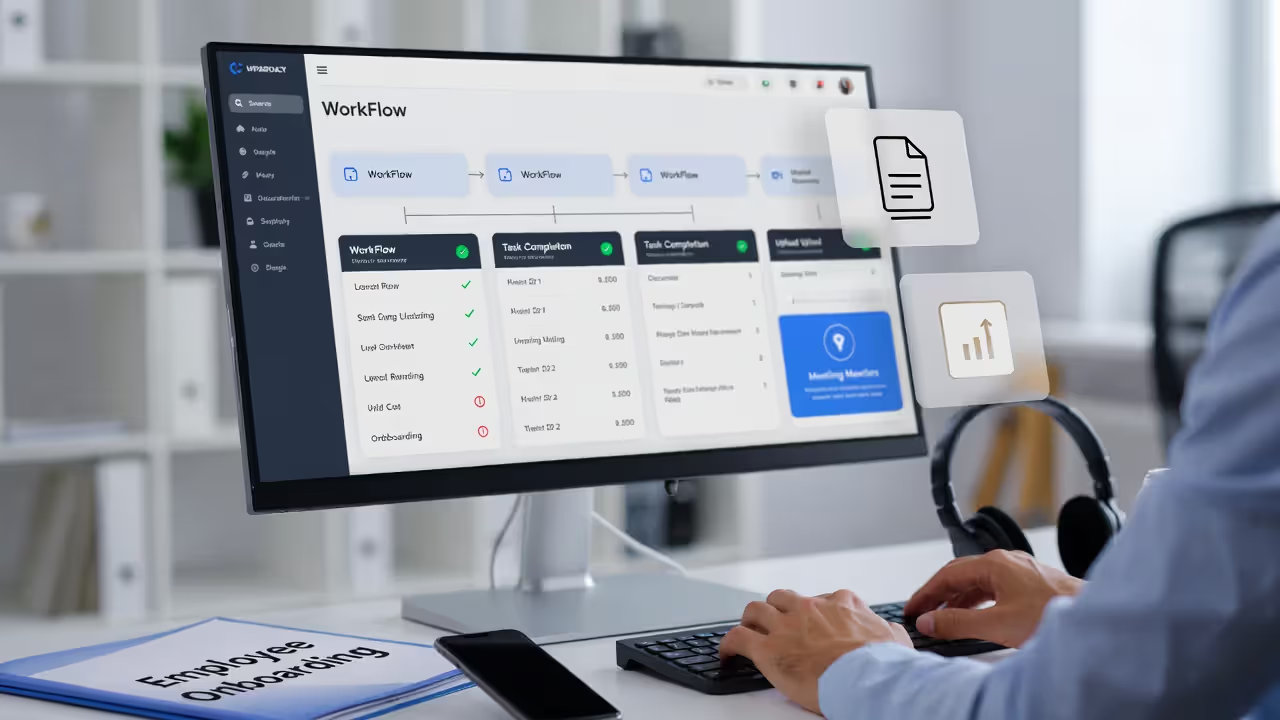
Automated hr systems handle repetitive tasks that consume HR staff time: sending reminder emails about incomplete paperwork, tracking training completion, scheduling introduction meetings, and generating reports on onboarding progress. These platforms reduce administrative burden while ensuring consistency across all new hires.
Document management human resources functionality centralizes everything from signed offer letters to completed compliance training certificates. Instead of hunting through email attachments or filing cabinets, HR teams access a complete record of each employee's onboarding journey in seconds. This becomes particularly valuable during audits or when addressing disputes about what information was provided when.

Author: Melissa Bradford;
Source: alignedleaderinstitute.com
The market offers several categories of solutions, each suited to different organizational needs:
| System Type | Best For | Key Features | Integration Capabilities | Price Range |
| Cloud-based HR systems | Small to mid-sized companies needing flexibility and remote access | Mobile-friendly interfaces, quick deployment, automatic updates, scalable user licenses | API connections to major payroll providers, applicant tracking systems, and benefits platforms | $5-15 per employee/month |
| Enterprise HR systems | Large organizations with complex compliance needs and multiple locations | Advanced workflow automation, custom reporting, multi-language support, dedicated account management | Deep integration with existing ERP systems, custom API development, single sign-on across platforms | $50,000+ annual licenses plus implementation costs |
| Standalone onboarding platforms | Companies with existing HRIS that need specialized onboarding features | Focused feature sets, superior user experience for onboarding-specific tasks, faster implementation | Limited to onboarding scope but strong integrations with popular HR and payroll systems | $3-10 per employee/month |
HCM human resources platforms (Human Capital Management) represent comprehensive solutions that combine onboarding with recruiting, payroll, benefits administration, performance management, and workforce analytics. These integrated approaches eliminate data silos—information entered during onboarding automatically populates payroll systems, for example, reducing duplicate entry and errors.
The trade-off: comprehensive platforms require longer implementation timelines and more significant change management than point solutions focused solely on onboarding.
When evaluating hr & payroll systems integration, verify that onboarding data flows bidirectionally. New hire information should transfer to payroll automatically, while payroll changes (like salary adjustments or department transfers) should update the employee record across all modules without manual intervention.
Author: Melissa Bradford;
Source: alignedleaderinstitute.com
How Educational Background Influences Onboarding Strategy Design
HR professionals who hold a bs in human resources or degrees human resources management typically approach onboarding with frameworks grounded in organizational behavior theory, adult learning principles, and change management models. This formal education creates noticeable differences in program design compared to self-taught practitioners.
Degree programs emphasize socialization theory—the academic concept that explains how newcomers learn organizational culture, norms, and role expectations. HR professionals with this background deliberately design onboarding to address what researchers call the "four Cs": compliance, clarification, culture, and connection.
They're more likely to incorporate spaced learning rather than information dumps. Instead of eight hours of training videos on day one, they schedule shorter modules distributed across the first month, applying the spacing effect that cognitive science shows improves retention.
Professionals with formal education also tend to implement more rigorous measurement systems. They track leading indicators (training completion rates, manager check-in frequency) alongside lagging indicators (90-day retention, time-to-productivity) because their coursework covered HR analytics and evidence-based management.
This doesn't mean self-taught HR professionals can't build excellent onboarding programs—many do. But formal education provides a shared vocabulary and research foundation that accelerates program development and helps justify budget requests to leadership with data rather than intuition.
For organizations building HR teams, combining professionals with formal degrees and those with practical experience creates the strongest foundation. The former brings theoretical frameworks; the latter brings pattern recognition from seeing what actually works across different contexts.
Common HR Onboarding Mistakes and How to Avoid Them
Mistake 1: Information overload in the first 48 hours
Presenting 40 policies, 12 training modules, and 20 new colleagues in two days guarantees that new hires retain almost nothing. The solution: distribute information across the full onboarding timeline based on when employees actually need it. Benefits enrollment details matter in week one; the intricacies of the annual review process can wait until month two.
Mistake 2: Manager abdication
When HR owns the entire onboarding process without meaningful manager involvement, new hires struggle to understand role-specific expectations and team dynamics. Managers should conduct the day-one welcome, schedule weekly check-ins for the first month, and personally introduce the new hire to key collaborators. HR provides the framework; managers deliver the context.
Mistake 3: No feedback mechanism
Organizations that never ask new hires "How is onboarding going?" miss early warning signs of problems and opportunities for improvement. Implement brief pulse surveys at 7, 30, and 60 days with questions like "Do you have the resources needed to do your job?" and "How likely are you to recommend this company to others?" Anonymous feedback reveals issues employees won't raise directly.

Author: Melissa Bradford;
Source: alignedleaderinstitute.com
Mistake 4: Treating remote onboarding as an afterthought
Remote employees need more structured onboarding, not less. Without casual hallway conversations or the ability to observe team interactions, remote workers miss informal learning that happens organically in offices. Over-communicate via video calls, create virtual coffee chats with team members, and ship a welcome package with company swag to build connection.
Mistake 5: One-size-fits-all approaches
A software engineer, a sales representative, and a financial analyst need different onboarding experiences. While company-wide elements remain consistent, role-specific tracks should address unique tools, workflows, and success metrics for each function. Template fatigue—where HR uses identical checklists for every role—leads to irrelevant activities and wasted time.
Mistake 6: Ending abruptly at 90 days
Turnover risk doesn't disappear after the first quarter. Schedule a six-month check-in to discuss career development, a nine-month conversation about expanded responsibilities, and a one-year milestone celebration. These touchpoints cost little but dramatically improve retention.
Effective onboarding increases new hire retention by 82% and productivity by over 70%. Companies that treat onboarding as strategic investment rather than administrative burden see faster time-to-productivity, stronger cultural alignment, and significantly lower turnover costs.
— Dr. Talya Bauer
Measuring Onboarding Success: Metrics That Matter
Effective measurement requires tracking both process metrics (are we doing what we planned?) and outcome metrics (is it working?).
Time-to-productivity: How long until a new hire performs at the expected level for their role? Baseline this metric by asking managers when recent hires reached full productivity, then track whether onboarding changes reduce this timeline. A reduction from 120 days to 90 days represents significant value.
90-day retention rate: What percentage of new hires remain employed after three months? Calculate this separately from overall turnover to isolate onboarding effectiveness. If your company-wide annual turnover is 15% but 90-day turnover is 25%, onboarding represents a specific problem area.
New hire satisfaction scores: Survey employees at 30, 60, and 90 days with questions about their onboarding experience. Track trends over time and investigate scores below 7 on a 10-point scale. Exit interview data from departing employees often reveals onboarding failures that satisfaction surveys can catch earlier.
Completion rates: What percentage of new hires finish all assigned onboarding activities on schedule? Low completion rates might indicate unrealistic timelines, unclear instructions, or lack of manager accountability. Drill down to identify which specific modules or activities employees skip most often.
Manager engagement scores: Survey hiring managers about their involvement in onboarding. Questions might include "Did you meet with your new hire weekly during their first month?" and "Did you clearly communicate 30-day objectives?" Low scores here predict poor new hire outcomes.
Health and human resources metrics: Track whether new hires enroll in wellness programs, use employee assistance resources, or participate in health screenings during onboarding. Early engagement with these benefits correlates with long-term utilization and employee wellbeing. Organizations that integrate health and wellness into initial onboarding see 23% higher participation rates than those that treat it as separate from the core process.
The most sophisticated organizations calculate onboarding ROI by comparing the cost of their program (HR staff time, technology expenses, manager hours) against the savings from reduced turnover. Replacing an employee typically costs 50-200% of annual salary depending on role level. If improved onboarding prevents just three departures annually in a 100-person company, the program likely pays for itself.
FAQ: HR Onboarding Questions Answered
The difference between employees who thrive and those who leave within months often comes down to those first 90 days. Organizations that treat onboarding as a strategic priority rather than an administrative checkbox see measurable returns: higher retention rates, faster productivity, and stronger cultural alignment.
Building an effective program requires moving beyond orientation-only approaches to structured timelines that extend through the first year. Technology platforms automate administrative tasks and ensure consistency, but they can't replace the human elements—manager involvement, peer connections, and regular feedback—that truly integrate new hires into organizational life.
Start by auditing your current process against the components outlined here. Identify the biggest gap: Is it pre-boarding communication? Manager accountability? Measurement systems? Fix that first, then iterate. Even small improvements compound when applied consistently across every new hire.
The companies that get onboarding right don't just fill positions faster. They build teams that stay, contribute, and grow.