

Strong performance management connects people, goals, and business results.
HR Performance Management Guide for Systems Process

Content
HR performance management is the systematic process through which organizations set expectations, monitor progress, provide feedback, and develop employees to maximize their contribution to business outcomes. Unlike transactional HR functions—payroll processing, benefits administration, or compliance tracking—performance management sits at the strategic intersection of talent development and organizational goals.
The distinction matters because many companies still confuse an annual review with true performance management. An hr appraisal is a single event; performance management is the year-round architecture that makes that appraisal meaningful. When Deloitte abandoned its traditional review system in 2015, they weren't eliminating performance management—they were acknowledging that a once-a-year conversation couldn't drive the continuous improvement their consultants needed.
The business case is straightforward. Gallup research shows that organizations with regular performance conversations see 14.9% lower turnover among high performers. Companies with mature performance management systems report 30% higher revenue per employee compared to competitors who treat reviews as box-checking exercises. The ROI extends beyond retention: aligned goals reduce duplicated effort, structured feedback accelerates skill development, and documented performance conversations protect organizations during employment disputes.
Yet most systems fail not from lack of intention but from poor execution. Managers conduct reviews three months late, using outdated templates that measure last year's priorities. Employees receive numerical ratings without understanding what behaviors would change those numbers. The gap between performance management theory and practice explains why 95% of managers report dissatisfaction with their current approach, according to a CEB Corporate Leadership Council study.
Core Components of an Effective Performance Management System

Author: Melissa Bradford;
Source: alignedleaderinstitute.com
Goal Setting and Alignment
Effective performance management starts with clarity about what success looks like. Goals must cascade from organizational strategy through department objectives down to individual contributors, creating line-of-sight between daily work and company priorities. When a customer service representative understands how their average handle time connects to the company's market expansion goal, performance conversations shift from compliance to collaboration.
The OKR framework (Objectives and Key Results) has gained traction because it separates aspirational objectives from measurable results. A sales team might have an objective to "dominate the mid-market segment" with key results like "achieve 40% market share in companies with 100-500 employees" and "reduce sales cycle to 45 days." The objective provides direction; the key results enable measurement.
Common mistakes include setting too many goals (research suggests 3-5 quarterly priorities), creating goals that employees can't influence (company revenue for an individual contributor), and writing vague aspirations ("improve customer satisfaction") without defining what improvement means numerically.
Continuous Feedback and Coaching
Annual reviews fail because humans need course correction faster than once per year. A software engineer who spends three months building the wrong feature has wasted a quarter; weekly check-ins would have caught the misalignment in week one. Continuous feedback doesn't mean constant formal meetings—it means normalizing quick corrections, reinforcing effective behaviors immediately, and separating coaching from evaluation.
Microsoft's shift to "Connects" (frequent, informal conversations between managers and employees) illustrates this principle. Managers ask three questions: What energizes you? What are your priorities? How can I help? The conversations rarely exceed 15 minutes, but they happen monthly. Employees report feeling more supported, and managers catch problems while they're still small.
The coaching element requires managers to ask rather than tell. Instead of "You need to improve your presentation skills," effective coaches ask, "What do you think made the executive team disengage during the Q3 review?" This approach develops problem-solving skills rather than creating dependency on managerial feedback.
Performance Reviews and Appraisals
The hr appraisal remains valuable when positioned correctly—not as the performance management system itself, but as a structured reflection point. Well-designed appraisals synthesize a year of feedback, document development, justify compensation decisions, and create a formal record for HR and legal purposes.
Modern hr appraisal system designs favor descriptive assessments over numerical ratings. Adobe's "Check-In" approach eliminated ratings entirely, focusing instead on expectations (what you'll accomplish), feedback (how you're progressing), and growth (what you're learning). Early results showed voluntary turnover dropped 30% after removing the anxiety and competition that numerical rankings created.
For organizations that need ratings for compensation distribution, calibration sessions help ensure consistency. Managers meet to discuss their proposed ratings before finalizing them, reducing the bias where one manager's "exceeds expectations" equals another's "meets expectations." The process adds time but dramatically improves perceived fairness.
Development Planning and Career Pathing
Performance management fails when it focuses exclusively on evaluation without development. Employees who receive feedback about gaps but no path to close them become frustrated. Development planning answers: What skills do you need for your next role? What experiences would prepare you? Who can mentor you?
Career pathing makes development concrete by mapping typical progression routes. A marketing coordinator sees that content managers typically need SEO expertise, project management experience, and a track record managing freelancers. This clarity lets them request relevant projects, seek specific training, and understand why their manager assigned them to lead the website redesign.
The most effective development plans include 70-20-10 learning: 70% from challenging assignments, 20% from relationships and feedback, 10% from formal training. A plan that lists three online courses misses the larger opportunity. Better: "Lead the Q2 product launch (70%), meet monthly with the VP of Marketing to review campaign performance (20%), complete the Advanced Analytics certificate (10%)."
HR Performance Management Software: Features and Selection Criteria
Author: Melissa Bradford;
Source: alignedleaderinstitute.com
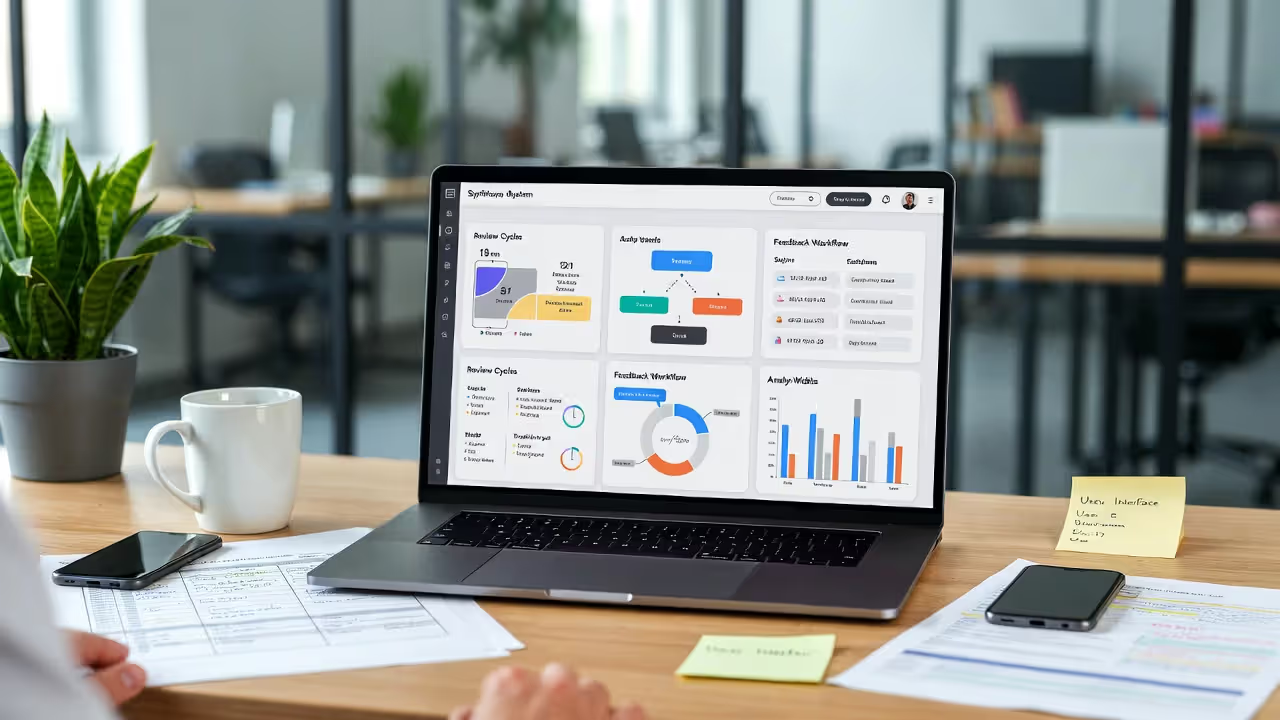
Modern performance management has moved from paper forms and spreadsheets into dedicated software platforms. A core hr system with performance capabilities centralizes goal tracking, automates review cycles, stores historical feedback, and generates analytics about organizational performance trends. The sophistication ranges from simple form builders to AI-powered platforms that suggest development resources based on skill gaps.
An hr automation system reduces administrative burden significantly. Instead of HR manually emailing 200 managers to remind them about pending reviews, the system sends automatic notifications, escalates overdue reviews to senior leaders, and generates completion dashboards. This automation frees HR to focus on coaching managers through difficult conversations rather than chasing paperwork.
Integration with an hr application tracking system or ats human resources creates powerful connections between hiring and performance. When your ATS captures the competencies you hired someone for, your performance system can track development of those same competencies over time. This closed loop helps refine job descriptions (if everyone hired for "strategic thinking" struggles with it, perhaps the interview process isn't assessing it accurately) and identify high performers for internal mobility before they start job hunting.
| System Type | Key Features | Best For | Price Range | Integration Capabilities |
| Standalone performance management software | Goal tracking, review workflows, 360 feedback, development planning | Mid-size companies (100-1,000) with existing HRIS | $8-15 per employee/month | APIs for most major HRIS, ATS, and LMS platforms |
| Core HR suite with performance module | Performance + payroll, benefits, time tracking, recruiting | Growing companies consolidating systems | $12-25 per employee/month | Native integration across all modules |
| Free/open-source HR systems | Basic goal setting, simple review forms, manual workflows | Startups under 50 employees, budget-constrained nonprofits | Free (self-hosted) or $3-5 per employee/month (cloud) | Limited; often requires custom development |
| Enterprise HRIS with automation | Advanced analytics, succession planning, AI-powered insights, compliance tools | Large organizations (1,000+) with complex needs | $20-40+ per employee/month | Comprehensive ecosystem with vendor partnerships |
When evaluating options, consider your manager-to-employee ratio. Companies where managers oversee 15+ direct reports need more automation than those with smaller teams. Assess your review complexity: simple annual reviews work fine in basic systems, but matrix organizations with multiple raters need sophisticated workflow engines. And honestly evaluate your change management capacity—the most feature-rich platform fails if managers won't adopt it.
Many organizations start with a free hr system to test performance management processes before investing in premium tools. OrangeHRM and OdooHR offer basic performance modules at no cost. The limitation isn't features—it's scalability and support. When 50 employees becomes 200, the manual workarounds that seemed acceptable create unsustainable administrative burden.
Building Your HR Performance Management Team: Roles and Qualifications
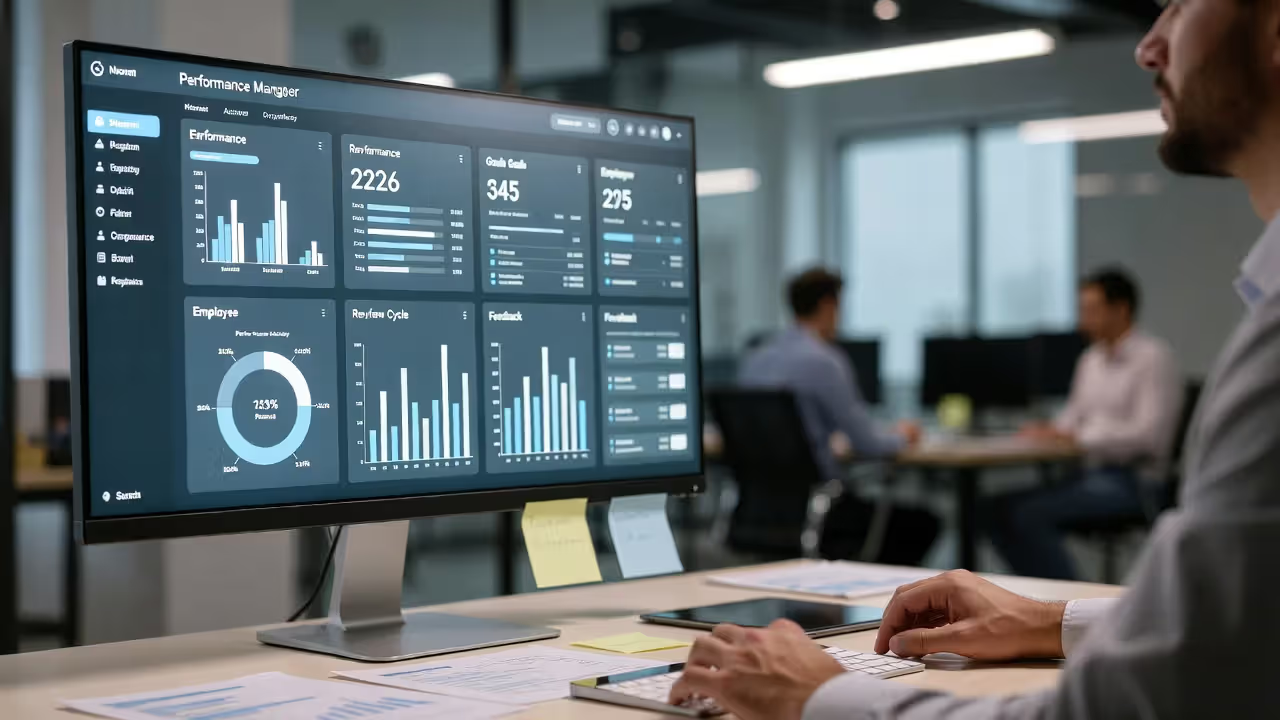
Performance management doesn't run itself. Someone must design the process, train managers, handle exceptions, analyze trends, and continuously improve the system. In small companies, a generalist HR manager wears this hat among many others. In larger organizations, dedicated talent management or organizational development teams own performance management as their primary focus.

Author: Melissa Bradford;
Source: alignedleaderinstitute.com
The chief human resources officer sets the strategic direction for performance management, ensuring it aligns with business priorities and culture. A CHRO at a fast-growing tech startup might champion quarterly goal cycles and peer feedback to support agility, while a CHRO in healthcare might emphasize competency assessments and compliance documentation. Their role includes securing executive sponsorship, allocating budget for systems and training, and holding senior leaders accountable for modeling effective performance conversations.
HR business partners typically handle the operational aspects: training managers on giving feedback, coaching leaders through difficult performance conversations, facilitating calibration sessions, and investigating performance-related complaints. These roles require both technical knowledge and interpersonal skill—understanding the mechanics of a 360 review matters less if you can't help a defensive manager hear critical feedback.
Certification for human resources adds credibility and ensures foundational knowledge. The SHRM-CP (Society for Human Resource Management Certified Professional) and PHR (Professional in Human Resources) certifications both cover performance management principles, legal considerations, and best practices. For specialists, the SHRM-SCP (Senior Certified Professional) or SPHR (Senior Professional in Human Resources) signals advanced expertise. These credentials don't guarantee competence, but they demonstrate commitment to the profession and provide a common knowledge baseline.
A bba in hr management or related degree provides theoretical grounding in organizational behavior, employment law, and talent development. Entry-level HR coordinators often handle the administrative aspects of performance management—scheduling reviews, compiling feedback forms, generating reports—while they build the experience needed for strategic roles. The degree helps them understand why performance management practices exist, not just how to execute them mechanically.
Practical experience matters more than credentials for senior roles. An HR director who has redesigned a performance system, managed a transition from annual to continuous feedback, and coached 50 managers through difficult terminations brings wisdom that no certification test captures. When building your team, balance formal qualifications with hands-on experience managing the messy reality of human performance.
Author: Melissa Bradford;
Source: alignedleaderinstitute.com
How to Implement an HR Appraisal System: Step-by-Step Process
Month 1-2: Assessment and Design
Start by diagnosing your current state. Survey employees and managers about what works and what frustrates them. Review completion rates, time-to-complete, and correlation between ratings and actual performance outcomes (promotions, terminations, high-performer retention). Many organizations discover that their 12-page review form gets completed by 60% of managers, three months late, with ratings clustered around "meets expectations"—a system that creates work without value.
Design your new approach based on your culture and business needs. A professional services firm billing by the hour needs different performance metrics than a manufacturing plant focused on safety and efficiency. Decide review frequency (annual, semi-annual, quarterly check-ins), rating scales (if any), and who provides input (manager only, 360 feedback, peer reviews). Document the "why" behind each choice so you can explain the rationale to skeptical managers.
Month 3-4: System Selection and Configuration
If you're implementing new software, run a formal selection process. Create a requirements matrix with must-haves (mobile access, integration with your existing HRIS) and nice-to-haves (AI-powered development suggestions). Request demos from 3-5 vendors, involving actual managers and employees in the evaluation. A system that impresses the CHRO but confuses frontline managers will fail at adoption.
The debate between a free hr system and paid platform usually comes down to scale and support. A 30-person company can manage with OrangeHRM or even well-designed Google Forms. A 300-person company will quickly outgrow free tools when they need workflow automation, reporting dashboards, and vendor support for troubleshooting. Budget $10-20 per employee monthly for mid-market platforms; enterprise systems cost more but include implementation support and change management resources.
Configure the system to match your designed process. Customize form fields, set up automated reminders, create manager and employee dashboards, and integrate with your core hr system so employee data flows automatically. Test thoroughly with a small pilot group—nothing erodes confidence faster than a system that crashes during the first review cycle.
Month 5: Training and Communication
Train managers first, focusing on skills not just system mechanics. Role-play difficult conversations: How do you tell a long-tenured employee they're no longer meeting expectations? How do you deliver feedback about interpersonal issues? Many managers avoid honest performance conversations because they lack the skills to deliver hard messages constructively. Two hours of system training without conversation practice sets them up to fail.
Communicate the "why" to employees repeatedly. People resist change when they don't understand the purpose. Instead of "We're implementing a new hr appraisal system," explain: "You've told us that annual reviews feel disconnected from your daily work. We're shifting to quarterly conversations so you get feedback while it's still relevant and can course-correct faster." Address concerns directly: Will ratings affect my bonus? What if my manager and I disagree? What happens to feedback from the old system?

Author: Melissa Bradford;
Source: alignedleaderinstitute.com
Month 6: Pilot Launch
Roll out to a pilot group—a single department or a cross-section of teams. Choose managers who are influential, open to feedback, and representative of your broader population. A pilot with only your most tech-savvy early adopters won't surface the adoption barriers that typical managers will face.
Gather feedback aggressively. What took longer than expected? Where did people get confused? What features went unused? A common discovery: the elaborate development planning section that seemed important in design gets skipped by 80% of managers who feel overwhelmed. Better to simplify based on actual usage than force a comprehensive process that nobody completes.
Month 7-8: Full Rollout
Launch organization-wide with strong executive sponsorship. Have your CEO and leadership team complete their reviews first, demonstrating that performance management applies to everyone. Address technical issues quickly—a slow system or broken mobile app will be cited as reasons to revert to the old way.
Expect resistance. Some managers will claim they're too busy, that their team is different, that continuous feedback doesn't work in their function. Hold firm on non-negotiables (everyone participates, reviews happen on time) while showing flexibility on details (if monthly check-ins don't fit your team's rhythm, try every six weeks). Celebrate early wins: share stories of managers who had breakthrough conversations or employees who appreciate the increased feedback.
Ongoing: Iteration and Improvement
Review metrics quarterly. Are completion rates improving? Do employees report feeling more supported? Are high performers staying longer? Use this data to refine the process. Perhaps quarterly reviews are too frequent for senior roles; maybe new employees need monthly check-ins for their first year. Performance management should evolve as your organization grows and changes.
Common mistakes to avoid: implementing during your busiest season (retail during holidays, accounting during tax season), changing too many things simultaneously (new system, new process, new rating scale), and declaring victory after launch without ongoing reinforcement. Budget 20% of your implementation time for the first year of post-launch support.
The biggest mistake organizations make is treating performance management as an HR program rather than a fundamental management practice. When it's positioned as something managers do for HR instead of a tool that helps them be more effective, it becomes a compliance exercise that adds no value.
— Marcus Buckingham
Measuring the Success of Your Performance Management Strategy
Effective performance management should improve business outcomes, not just generate completed forms. Start with leading indicators that signal whether the system is working: review completion rates, time-to-complete, manager and employee satisfaction scores. If only 70% of reviews happen on time, the downstream impacts don't matter—you have an adoption problem to solve first.
Employee engagement scores often correlate with performance management quality. Pulse surveys that ask "I receive regular feedback on my performance" and "I understand what's expected of me" provide early warning signs. Declining scores suggest your performance conversations aren't happening or aren't landing effectively. Compare scores between teams to identify managers who need coaching versus those who could mentor peers.
Retention metrics reveal whether performance management supports or undermines your talent strategy. Track regrettable turnover (high performers you wanted to keep) and segment by whether employees had regular performance conversations. If your best people leave despite good reviews, perhaps your system isn't identifying development opportunities or career paths. If low performers stay for years with "meets expectations" ratings, your managers aren't having honest conversations.
Quality of hire improves when performance management closes the loop with recruiting. Compare the competencies you hired for against 12-month performance results. If employees hired for "strategic thinking" consistently struggle in that area, your interview process isn't assessing it effectively. Use performance data to refine job descriptions, interview questions, and assessment criteria.
Promotion and succession readiness metrics show whether your system develops internal talent. What percentage of leadership positions are filled internally? How many employees have documented development plans? How long does it take to identify successors for critical roles? Organizations with mature performance management can answer these questions with data, not guesswork.
Revenue per employee, productivity metrics, and customer satisfaction scores represent ultimate business outcomes. These lag indicators take time to move, but they validate whether performance management contributes to results. Control for external factors (market conditions, product changes), but track trends over multi-year periods. Companies that invest in performance management should see measurable improvements in business performance.
Create feedback loops by surveying managers and employees after each review cycle. What worked? What felt like busy work? What would make the next cycle more valuable? Use this qualitative feedback to complement quantitative metrics. Sometimes the data looks good (95% completion) while the experience feels terrible (managers rushing through 15 reviews in the final week).
Benchmark against industry standards cautiously. Your technology startup shouldn't adopt the performance management approach of a century-old manufacturer just because they're both "large companies." Context matters more than comparison. That said, understanding that similar organizations conduct reviews semi-annually or use 360 feedback helps you make informed choices rather than operating in a vacuum.
Frequently Asked Questions About HR Performance Management
HR performance management succeeds when it serves managers and employees first, HR administration second. The best systems make expectations clear, normalize feedback as a gift rather than criticism, document development over time, and connect individual work to organizational success. They reduce the anxiety of annual reviews by making performance conversations routine rather than rare.
Implementation requires more than selecting software. You need executive sponsorship, manager training, clear communication about purpose, and willingness to iterate based on feedback. Start simple—basic goals, regular check-ins, streamlined reviews—and add complexity only when the foundation is solid. A sophisticated system that nobody uses helps no one.
The organizations that excel at performance management treat it as a core management capability, not an HR compliance requirement. They measure success by business outcomes—retention, engagement, productivity—not just completion rates. They invest in developing managers as coaches, not just evaluators. And they recognize that performance management is never "finished"—it evolves as the organization grows, the workforce changes, and new research reveals better approaches.
Whether you're implementing your first formal performance management process or redesigning a system that has grown stale, focus on the fundamentals: clarity about expectations, regular feedback, honest conversations, and genuine development. The rest is details.